08 June 2018

Not If I See You First / Eric Lindstrom


3/5

Parker Grant is blind, not helpless, and she has rules to make sure things stay that way. She doesn't tolerate any mistreatment, and her inability to see people's faces and reactions makes it easy for her to cut anyone she doesn't like out of her life. But what if things aren't as black and white as they seem, and her harsh demeanor and strict rules become more harmful than helpful?

Not If I See You First allowed me to experience the perspective and life of someone I probably wouldn't otherwise. I learned about how Parker lives her life without sight, and how that has not only shaped her actions but her personality and her outlook. She's headstrong and carefree, traits that make for a fun lead, but as I read on I began to see how these traits were hurting her. It was wonderful to watch her discover that for herself. One thing I didn't like was how towards the end, the romance storyline really took over the plot. The ultimate focus of the novel, though, was on Parker's growth and her development with other characters (pay special attention to her sister, it is one of the most interesting relationships in the novel) and the romance doesn't cause Parker to lose sight of herself. 

Eric Lindstrom does a wonderful job in Parker's growth and development, and I would recommend Not If I See You First to fans of teen romance, realistic fiction, and coming-of-age novels.

Children of Blood and Bone / Toni Adeyemi


1.5/5

Children of Blood and Bone is a West African- inspired fantasy novel filled with magic. Magic in the land of Orisha is suppressed by the king, and Zelie has lived her whole training to stay safe as a maji. When she gets tangled up in a mission to save magic and in a run-in with a conflicted princess, she also finds herself messily tied to the prince.

Blood and Bone is ambitious in its goals of representing West-African culture. I'm not familiar with West-African culture so I can't say how accurate the novel is, but I greatly enjoyed hearing about different beliefs and traditions, and I admire Toni Adeyemi for her efforts toward representation and the beautiful world she created. But other than representation efforts, there aren't many compliments I can give Blood and Bone. 

The set up for the novel is full of high stakes action and life-or-death intensity, but the writing simply doesn't deliver. Blood and Bone switches perspectives between Zelie, Amari, and Inan, and though their voices were written differently, the difference was not as great as it should have been between characters that are so different. I didn't have a problem differentiating because what they said and the context of the narration made it clear, but I think the chapters would have benefited from more distinct writing styles. The writing often felt cliche in terms of dialogue and plot (such as in the opening scene, or whenever someone got jealous). My biggest problem with the novel, though, are the characters. I like Zelie's brother, although his overreaction towards the end of the book felt very much like a plot device to add more drama and fills the book with too much testosterone. Amari has the best character development, I enjoy her but her role isn't large enough. She feels like a flimsy character that Adeyemi brushes past in favor of Zelie and Inan, the worse half of the four main characters. Zelie isn't the worst lead but she is definitely not strong or smart enough to be a favorite. And Inan is by far, the weakest, most painfully difficult character to read. He is spineless throughout the entire novel, he does disgusting and immoral actions to those he claims he loves, and to make things even worse, Zelie, our supposedly "strong" female lead, accepts it!

If you are looking for fantasy and magic, I would recommend Strange the Dreamer or the Grisha trilogy. 

05 May 2018

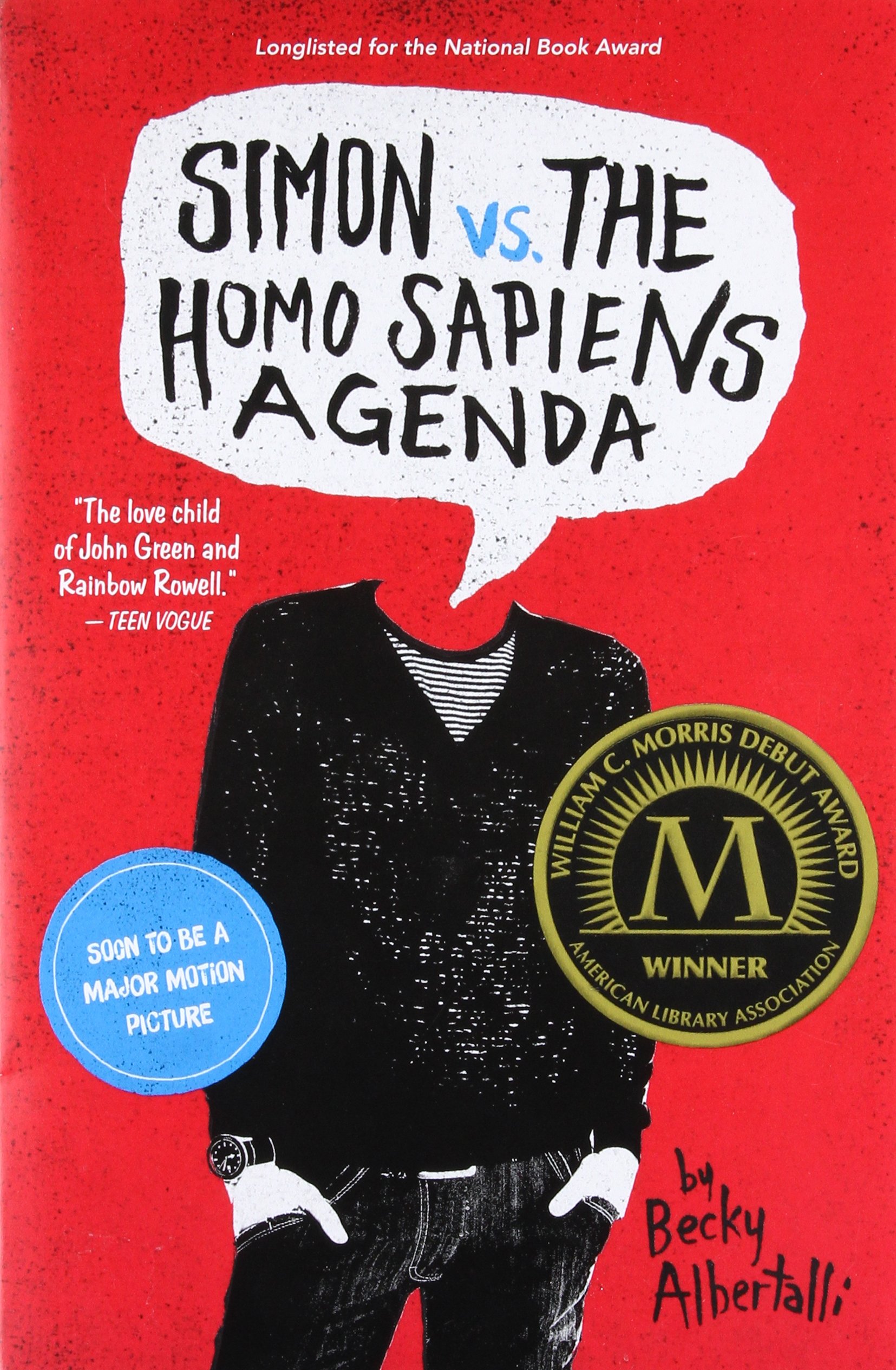
Simon vs. The Homo Sapiens Agenda


4/5

I read Simon vs The Homo Sapiens Agenda in one sitting at the airport. I actually wished that my flight would be delayed because that's how desperately I wanted to be able to sit there and finish the last chapter without interruption.

Simon vs The Homo Sapiens Agenda is a well-written coming-of-age novel that I would recommend to John Green fans and really all fans of YA realistic fiction. Becky Albertalli writes Simon as an honest teenage boy. I loved hearing his point of view and the challenges he faced that are so different from most, or at least not so often acknowledged, in mainstream media. The narration is humorous and the changes in format helped to keep the novel lighthearted and interesting. One thing in particular that I loved, other than Simon's character and voice, was piecing together who Simon is and how he is perceived by others by reading his friends' descriptions of him and his friends' actions. It was a really fun puzzle to solve and very thought-provoking to hear Simon's perspective, and be Simon, while at the same time seeing how other people's perception of him is different from what he and I both thought of him. 

I also enjoyed Love, Simon, the film adaptation, and as always I recommend reading the book before watching the movie! Simon vs The Homo Sapiens Agenda is the new TFIOS, at least in terms of popularity; this is recognition that's well-deserved and I would recommend not only YA fans but anyone who wants to stay in touch with this generation to pick it up immediately.

18 April 2018

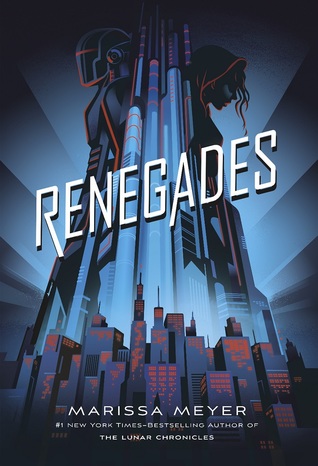
Renegades / Marissa Meyer


3.5/5

In the world of Renegades, people with powers exist and they're called prodigies. Prodigies were persecuted until Ace Anarchy rose up and established the Age of Anarchy, where prodigies refused to hide any longer and embraced their powers, calling themselves Villains. In response to the Villains running rampant, other prodigies arose, calling themselves the Renegades, and destroyed the Villains. As the Renegades rebuild the city and their influence grows, Villain prodigies find themselves in hiding again; how can the cycle end? Nova Artino, a prodigy with Villain connections, is sent to infiltrate the Renegades, and becomes caught between the two sides. 

Renegades blurs the lines between the good guys and the bad guys, and questions the meaning of the word "hero." Marissa Meyer takes a hard look at the role of government and law enforcement, and how having power changes the way people view one another, the way they view themselves, and the way they interact with one another. I love books with moral ambiguity and shades of gray, so I enjoyed those themes in Renegades; but there are many moments that are just paragraphs of introspection, and while I really enjoy philosophical thinking, many of these passages repeat themselves. One other thing that kept Renegades from being truly stellar to me is that I felt like Meyer could have fit a lot more plot and action into a novel of this length. It's not so much that the novel was slow, just that it didn't hit a certain level of intensity. There were a few high-stakes moments that had my heart racing, but overall the novel didn't have the drive I would have liked. Adding to that, both Nova and Adrian are a little slow. Each of their hidden identities are incredibly obvious, and I found it ridiculously unbelievable that by the end of a book of that length, both of their secret identities were still intact. 

I'm a fan of Marissa Meyer, and though Renegades can't compare to the Lunar Chronicles, it holds up strong against many other YA fantasy novels. Nova is smart and quick, Adrian is conflicted and compassionate, and the variety of characters are all exciting to meet. The surprise at the end of the novel is not much of a surprise, but definitely enough of a twist to make me want to read the sequel (the fact that this is a duology doesn't hurt either). I would recommend Renegades to Marissa Meyer fans, Strange the Dreamer fans, and fans of moral ambiguity.

16 April 2018

Boys Don't Knit (In Public) / T.S. Easton


3.5/5

Boys Don't Knit is well-written story from the point of view of high school underclassman Ben Fletcher. After an incident that wasn't completely his fault, Ben is essentially on probation and must take knitting classes as a way to give back to his community. The novel is not only about Ben finding out that he loves knitting, but also coming to terms with who he is and where exactly he stands in his relationships to those around him.

T.S. Easton does an excellent job in Boys Don't Knit of capturing the stubbornness and immaturity of adolescence but also the natural depth and compassion in Ben. Ben is what most would call a nerd; he likes to keep his head down, stick to the rules, and loves cleanliness. Easton takes what most would find annoying traits and makes Ben relatable and human, and I loved that. The novel is also unfailingly funny; I found myself laughing at Ben's sense of humor, conveyed through various forms, such as his emails. Ben also experiences a huge amount of growth in all of his relationships, from the ones with his mom and dad to the ones with his friends, and with many other people that he probably never expected anything from. The development was natural, and watching Ben slowly grow made me proud.

Overall, Boys Don't Knit is skillfully written and a delight to read. The voice and tone is suitable for a younger audience (it would be middle school appropriate); it is definitely enjoyable for all ages, but just know that going in. I would definitely recommend Boys Don't Knit as a sweet, funny fiction read.  

24 March 2018

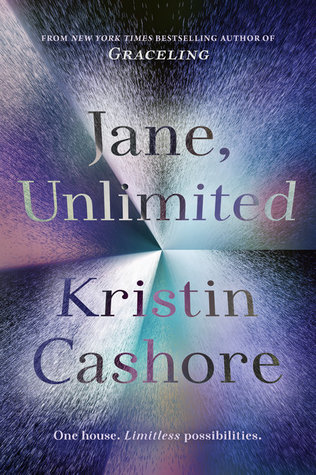
Jane, Unlimited / Kristin Cashore


2.5/5

In Jane, Unlimited, Kristin Cashore writes five possible courses of events that all vary depending on a decision Jane makes in an instant. The novel is set in a fantastical world written in a sleepy sort of magical narration.

The reviews for Jane, Unlimited had me pumped up for an experience of a novel unlike any other, and while Jane is different from most other novels I've read in terms of style, I did not enjoy it. I like Cashore's idea of having completely different events happen to Jane depending on what decision she makes. I love how it shows that perhaps it is only possible to know a certain amount of information, because a certain choice can only lead you down a certain path. It also reinforces the possibility of multiple universes, which is discussed in the novel. But in splitting the novel into five different stories, eventually I lost interest. My loss of interest was also due to how the level of ridiculousness and extreme magic increased; the novel started off bordering on the bizarre, which is part of its charm, but the last two stories in particular were far too much for me to buy. If you read it, you'll understand what I mean. If not, let me try to explain without spoiling by saying that the new worlds Cashore introduces in these storylines are not hinted at enough earlier in the book to avoid feeling like ridiculous, childish stretches. I was relieved to finish the novel because reading the last two stories felt like a waste of time-- I stuck through it I expected Cashore to wrap up all of the storylines in some way at the end. The wrap-up didn't happen, but I think that suits the novel's theme of multiple possibilities and stories with no ending.

Jane, Unlimited offers a different style of storytelling than is usually seen in YA literature. Cashore also creates some excellently developed characters, and the relationships between them are also of the kind not usually seen. Jane's relationship with Kiran isn't the typical best friends 'til death type. Her feelings toward Ivy are well-captured and a consistent highlight throughout the entire novel. Her descriptions and changing opinions of Aunt Magnolia are different in every story, a testimony to Cashore's writing, and I enjoyed meeting Ravi. 

But overall, Jane, Unlimited is long and dragged out, and the stories do not feel worth the time at all. If you're curious to experience this type of storytelling, then I'd recommend picking it up, but first quickly flipping through the entire book to see if it's something you truly want to invest your time in. Don't worry, this type of book won't be spoiled by flipping to the end. 

21 March 2018

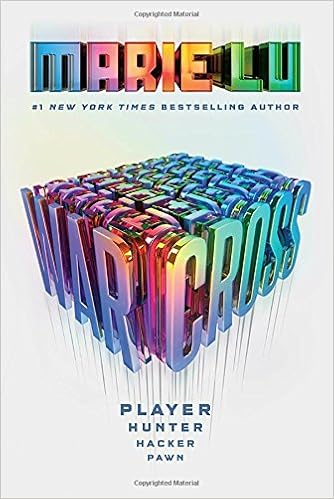
Warcross / Marie Lu


4.5/5

Warcross is exciting and new and has me anxiously anticipating the sequel. Marie Lu, you've got me again.

Set in futuristic world where everyone is connected into a virtual reality game called Warcross, Marie Lu weaves the story of Emika Chen after Emika hacks her way through Warcross security and earns the notice of Warcross founder Hideo Tanaka. Hoping to use Emika's hacking talent to his advantage, Hideo invites her to participate in the Warcross championship games while helping him address a bigger threat: an anonymous hacker trying with an unknown endgame. 

First, I want to recognize the diversity Lu included in her novel. Warcross takes participants from all  over the world, and Lu makes sure that her characters reflect that. I loved the ethnic names and various languages, the LGBT representation, the characters with disabilities. And she included all of this without making a big deal out of it; their "differences" never had to be outrightly acknowledged because they're not differences at all-- they're normal. Walk around in the real world and you'll encounter plenty of ethnic names and non-straight people and people with disabilities-- it's normal. Other than diversity, Lu also included culture. I loved that she chose to place her novel against Tokyo, and that her main characters were Asian. As an Asian-American, I am painfully aware of how little representation Asian culture gets, and so this was very meaningful to me. Yes, Tokyo may have been the most sensible location for such a technology heavy plot, but I think Lu chose this location for more than that reason. Her writing shows her appreciation for Japanese culture, and I love that she was brave enough and proud enough to share that with the world, especially with how important it is to have this representation.

In case you couldn't already tell, I love Warcross-- I only write reviews this long when I feel very passionately! It has everything I need in a novel: strong characters and a plot that hooks me in. Emika is definitely strong, and reading her felt natural. Though at first the world may not seem extremely original, as there are plenty of novels that have similar futuristic technology, what Lu chooses to do with the technology is still exciting. Players face off in a virtual world, and I loved being thrown into all of these wild settings that defy physics and always have new obstacles. Throughout the novel I was always eagerly awaiting the next battle, the next twist, the next challenge. The speed grows and grows, and ending left me reeling in the best way.

I could go on about all of the well-developed characters, the intricate world, the fun action, but I think it's best if YA fantasy and science fictions lovers like me read Warcross and experience it themselves. I'm not saying the novel was flawless-- Emika's initial treatment of her teammates was understandable but frustrating, I would have liked to see more development between Emika and Hideo earlier on, and there were some technicalities that made me frown-- but Warcross was so fun that these details are almost trivial. Warcross has reminded me why I am such a steadfast fan of YA science fiction: it's a fun, exciting, wild ride that lets me live lives I couldn't otherwise.