19 December 2017

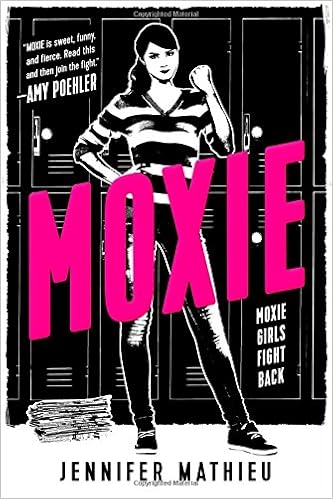
Moxie / Jennifer Mathieu


4.5/5

Jennifer Mathieu's Moxie takes a hard look at the realities of being a woman that girls encounter as early as high school. I devoured this novel in one day, and I am going to jump straight in and declare the reasons for my high rating, in no particular order.

Judging the title of the book, I assumed that our protagonist Vivian would be sassy and confident, maybe even rambunctious. I thought this novel would be about a loud and proud girl who would march through the halls of her school, rallying up the female population and threatening to fight anyone who stands in her way. Vivian could not be farther from that. She's the type of person who doesn't like attention or starting conflict. This is the first point of pleasant surprise: our protagonist is not who I assumed she'd be, and I was curious as to how Mathieu was going to pull this riot off with Vivian in the lead. This brings me to the next thing Mathieu does well, which is her delicate crafting of Vivian's character in these tricky situations. Vivian is hesitant and full of self-doubt. She's vulnerable and scared, and who wouldn't be? One of the worst fates that can befall a high-schooler is ostracization, which keeps everyone from declaring his or her true perspective. Mathieu executes Vivian's fear and internal conflict deftly and naturally, and makes Vivian far more real and relatable than the bold and brash heroine I was expecting.

I also appreciated the diversity included in Moxie. Mathieu acknowledges many issues aside from sexism and assault, such as race, tradition, pride, sexual orientation, and family, without ever feeling forced or overdone. Her characters are multi-dimensional; a good example is Vivian's relationship with Seth and how she views him against her progressive efforts. Also, pay particular attention to my favorites Claudia and Emma. Their plot lines really enforce the heart of Moxie, which is that this movement is for all girls. It doesn't matter whether you call yourself a feminist or not, whether you're the head cheerleader or social nobody; all girls means all girls. Mathieu portrays Vivian's encounters with all of these different people and new circumstances (such as Vivian trying to explain to Seth, who is a "not-a-dick," why she cares so much about this movement, and Vivian's shift in perspective of a girl she thought she had pinned down) with a subtlety and grace that I am just now realizing the extent of as I think back on the novel and type this.

The third main factor contributing to my admiration of Mathieu's work is the coherency of Moxie. Undercurrents of the same themes run through all of the storylines, but Mathieu executes this with a delicacy that avoids repetition and instead allows you to see what it means to truly take a stance and how your viewpoints can affect various aspects of your life, from family to love to friends. Mathieu captures the difficult part of standing for something: it's easy to claim your beliefs, but it's hard to actually apply them. In Moxie, we get to see Vivian discover what she believes in, grow into her beliefs, and learn how they fit into the different relationships and areas of her life.

To sum up, Moxie's message is impactful and important, and its delivery is well-crafted and honest. Mathieu expresses the diversity of her characters, the vulnerability of our protagonist, and the significance of Moxie's purpose in natural and seemingly effortless narration. I would compare Moxie to a more political The Lonely Hearts Club by Elizabeth Eulberg, an all-time favorite of mine that I also highly recommend. I recommend Moxie to feminists everywhere (male or female, of course), those who like a relatively light but also meaningful read, and fans of YA realistic fiction and of good writing. 

18 December 2017

Dividing Eden / Joelle Charbonneau


3/5

Dividing Eden is a fantasy novel telling the story of twins Carys and Andreus, and what will happen to their kingdom of Eden after the king and crown prince wind up dead. Neither Carys nor Andreus ever expected to have to take the crown, and now they must compete with each other, each the other's closest friend, for a throne neither had ever considered before.

The novel starts off slow. Charbonneau takes her time setting up, and the competition between the twins isn't introduced until about forty percent of the way in. She also writes almost exclusively in simple sentences, and dialogue from nearly all the characters sounds the same. The slow pace and boring writing almost had me giving up, but I'm glad I kept reading. Once the competition is introduced, the set-up Charbonneau spent so many words on comes into play. The speed picks up, the stakes rise, and the action is much more intense.

Dividing Eden would appeal to fans of Winner's Curse or Throne of Glass because it has the same elements of dreamy fantasy, tense political themes, and high-stakes competition. But Dividing Eden doesn't make it into the same league as these series because it doesn't possess the same originality, execution, or charisma. Though it can't compete at the same level, Dividing Eden can satisfy the withdrawal symptoms if you've recently finished one of these series.


13 December 2017

A Semi-Definitive List of Worst Nightmares / Krystal Sutherland


2.5/5

A Semi-Definitive List of Worst Nightmares is a coming-of-age novel about facing your fears, written in a melancholy tone and with subtle supernatural and mystical threads in it that lend the novel a dreamy feel.

The first thing that surprised me when I opened the book, on the very first page, was that it is written in third person. From the blurb Semi-Definitive List is sold as a novel with a humorous and witty protagonist, so I had assumed I would be reading from Esther's point of view. That it's written in third person was a surprise, but neither a good nor bad one, and didn't take away from the wittiness the blurb promised. In fact, third person allowed Sutherland to expand the range of narration from sarcastic teen to dramatic metaphors and emotional wisdom reminiscent of The Book Thief. After all, this is a book about Death, with a capital D, which leads me to how Semi-Definitive List personifies Death. I like Sutherland's imagination of Death because her description of her (or him) is similar to one I would imagine, and found the side plot of Esther's grandfather and his run-ins with the incarnate of Death to be one of the highlights of the novel. I found the ending of this storyline though, and how it relates to Esther, to be a little cheap.

So why the two-and-a-half star rating? Semi-Definitive List is, before anything else, a book about mental illness. While it started off strong with a sassy protagonist and a fast pace, it soon slowed down. It puttered to almost a complete stop about a fourth of the way in, and then ever so slowly the gears of plot began to turn again. They creaked and groaned and warmed up for maybe another one hundred pages, until Jonah and Esther had a little spat and some very hurtful and very honest things were said. (I would like to say that this scene is one of my favorites of the novel, because Jonah finally says the things that I wanted to say to Esther but didn't know how to put into words, so keep an eye out for this scene!)

Esther can be trying at times, but if you asked me what bothered me the most about her I would have to say all of her mental blocks, and this is the same problem that I have with nearly every single character in this novel. They all have mental blocks and they all have their problems and their demons. This is a novel about mental illness, and Sutherland does a very good job portraying it. But the novel was slow, and just like Esther acknowledges in the novel, people can only take so much of your mental illness before they get tired of it. I enjoyed learning about each character but Sutherland spent too much time introducing instead of developing. Several chapters are dedicated to Esther and Jonah knocking off the fears on her list, and it gets very repetitive. At around fear 12/50, I got so scared that I was going to have to read through all fifty fears that I actually flipped through the rest of the novel to see if the chapters were numbered up to fifty (and thank god they weren't, otherwise I might've stopped reading right then and there).

A Semi-Definitive List of Worst Nightmares is very similar to Patrick Ness's The Rest of Us Just Live Here and I would recommend it to fans of Ness's novel and fans of The Book Thief, although I would recommend The Rest of Us Just Live Here before Semi-Definitive List because it is shorter, sweeter, more touching, and more concise. Semi-Definitive List is not a bad book; its portrayal of mental illness is very well-done. But other than making strides in awareness of mental illness, A Semi-Definitive List lacks purpose.

03 December 2017

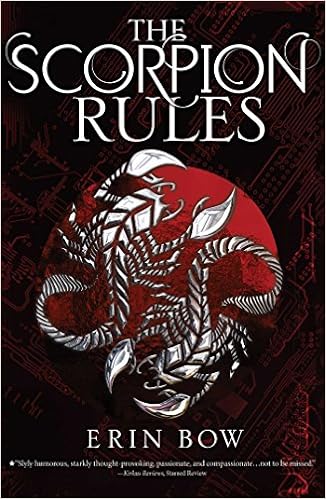
The Scorpion Rules / Erin Bow


1/5

The Scorpion Rules is set in the future when an AI named Talis has taken over the world, and to keep the peace between nations, has each country send its leader's child to be kept as a hostage, discouraging any national leader from declaring war.

I'm just going to jump straight into the issues I found with this novel. I was super excited for The Scorpion Rules because the premise was exciting and sounded like a Winner's Curse deal. But unfortunately, Erin Bow's novel lacked the traits I need in a novel. Greta, our protagonist, is bland, dull, and passive. Her lack of any interesting or admirable characters is worsened by the monotonous narration. I understand that Greta starts the novel as the goody-two-shoes and is supposed to grow stronger and more rebellious, but her development was portrayed poorly. It was told, not shown. I didn't feel any growth, and then about two-thirds into the novel, Bow adds in a few sentences where Greta blandly literally states she has changed without noticing in the past two weeks. And that was it for growth. 

By all rights, the plot should have been high-stakes and intense, but it never felt that way. Bow never gave me any reason to care about the characters. I never related or invested. My lack of interest and the boring plot was only exacerbated by the dull writing that consisted almost entirely of simple sentences, and most of these sentences were about farming. Yes, farming. Now, I have nothing against farming or agriculture or gardening, but it didn't forward the plot! 

So other than the boredom of the novel, the one other considerable problem I had with The Scorpion Rules is the portrayal of Talis. He is not human, and he rules the world, and he has implemented many cruel policies. And yet his dialogue is disturbingly similar to those of the hipster high school boys one would find in most YA realistic fiction novels. Bow writes him as witty and sarcastic, and this creates a very awkward contrast with Greta's dull narration. His character, put simply, is trying too hard.

I'm impressed with myself for just reaching the end of the novel. I started flipping pages at a consistently rapid place about halfway through, but started feeling bored less than a third of the way in. I was so happy when I reached the end. The Scorpion Rules was definitely not for me, and unless you can overlook the issues previously stated, I would not recommend it. 

29 November 2017

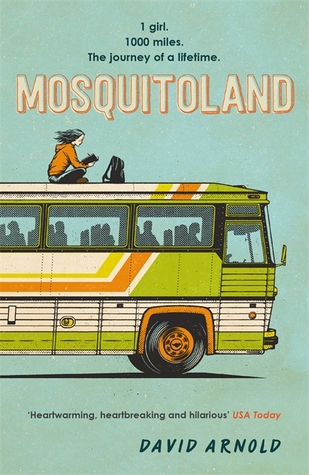
Mosquitoland / David Arnold


3/5

Mosquitoland by David Arnold is a novel about self-discovery and growth, set against the physical journey of bussing from Mississippi, aka Mosquitoland, to Ohio. This is the story of Mim, short for Mary Iris Malone, and how she fumbles her way through the avalanche of disasters that is her life.

Mim is an unreliable narrator and Arnold's capturing of her character, though from first person, never lets you forget it. I greatly enjoyed reading the wild tangents Mim's imagination would bring her to, and loved her fun exaggeration because it made me question the events of the novel. Arnold portrays a beautiful coming-of-age story in an original way not only through Mim's unreliability but also through journal entries, and I loved the multiple modes of storytelling. Mim's voice was always honest and easy to read, and her vulnerability and strength kept me engaged throughout the novel. 

I am not a huge fan of novels that focus solely on personal growth at the expense of believability. The book didn't seem to have much of a purpose other than looking at Mim's journey. Although it was a great journey, I prefer to have a strong sense of purpose running throughout the entire novel. The events of Mosquitoland felt more like loose wandering, with the only consistent being Mim and what these events taught her while the events themselves were not particularly interesting or special. 

I recommend Mosquitoland to fans of John Green and Sarah Dessen. Mosquitoland is perfect for those who love a coming-of-age novel that is narrated with a raw, honest, witty voice, and doesn't shy away from the grittiness of growth. 

17 November 2017

An Enchantment of Ravens / Margaret Rogerson


3/5

An Enchantment of Ravens is a young adult fantasy romance novel that tells the story of Isobel, who is a master of painting. She paints portraits of the Fair Folk, and when she paints human emotion into a portrait of the Autumn Prince, he steals her away for a trial in the Fair Folk lands. 

When calling this novel a fantasy romance novel, I put heavy emphasis on the romance. This is not to say that there aren't a lot of fantasy elements in the novel, because there are lot, but because the novel and plot are entirely driven by romance. The romantic aspects are introduced very early in the plot, but I hesitate to deem it "insta-love" because after reading the whole novel, I see how the romance plays into every part of the book. There are moments where I think others may find that Isobel is annoyingly weak, but I leaned on the more forgiving side and those moments didn't bother me. They were times of physical weakness, which I think were well-deserved given the circumstances she was in. Isobel is logical and clever, and I liked hearing her voice. I also really enjoyed the Aster storyline, and Lark is among one of my top characters for this novel.

Overall, An Enchantment of Ravens doesn't make it high on my list of top books because I like my novels to have more plot than just romance. But in terms of fantasy romance novels, Rogerson does an excellent job by creating a beautiful world, intriguing characters, and easy narration. I didn't put this book down until I finished it, and even went back to reread some parts I liked. I was invested in the characters and was eager to find out what would happen next. I recommend this to fans of Fae and fans of romance. 

14 November 2017

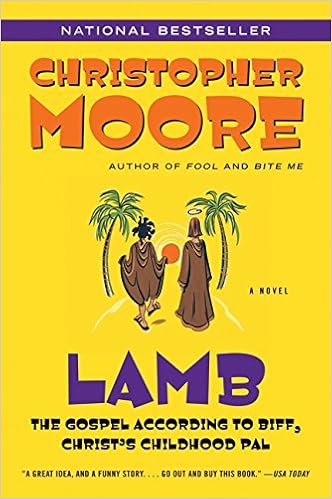
Lamb / Christopher Moore


4/5

In Lamb: The Gospel According to Biff, Christ's Childhood Pal, Christopher Moore takes advantage of the gap between Jesus's birth and his early thirties to write some stories of his own. Lamb is told from Biff's point of view, who has been raised from the dead in the modern day by the angel Raziel, and asked to write about the first thirty years of Jesus's life. 

Jesus, called Joshua in Lamb, and Biff are best friends. Moore does an amazing job of subtly capturing the dynamics of their relationship. Joshua, as the Son of God, is of course pure and kind, while Biff is impulsive and indulgent. There were times when Biff's sexual indulgences were a little too graphic, but throughout the novel Moore keeps Biff's tone and narration quick-witted and light, more than making up for it. I laughed aloud several times, which is rare for me when reading. Moore conveys the depth of Joshua and Biff's friendship without ever having to explicitly say it, and I greatly admire that. He also successfully writes Joshua as likeable and human, and those are hard traits to write into a character who is supposed to be one hundred percent good. I also enjoyed the sections regarding Biff's current situation, as he writes the past down. Not only did those sections allow us to experience Biff's witty narration in a modern setting, they also reveal how he changed and grew. 

One thing that bugs me slightly is Biff's choice toward the end of the novel, but I can understand why Moore had things go down that way. It was the only path that made sense, if Moore wanted to maintain some sense of plausibility. I teared up a little when Joshua was crucified (okay, that's not really a spoiler). The ending of Lamb is very bittersweet and provides a satisfying sense of closure. Moore wields Biff's voice expertly and commands a range of emotions out of his reader.

Overall, Lamb is a bit long but very humorous, making the ride fun and enjoyable. I loved reading about Joshua and Biff's story, learning about religion and history, and both laughing and tearing up. The book is full of journeys and adventures, and Biff's brilliant narration never falters. I recommend Lamb for fans of humor novels, those who aren't afraid to laugh a bit at religion, and those who love a good friendship.